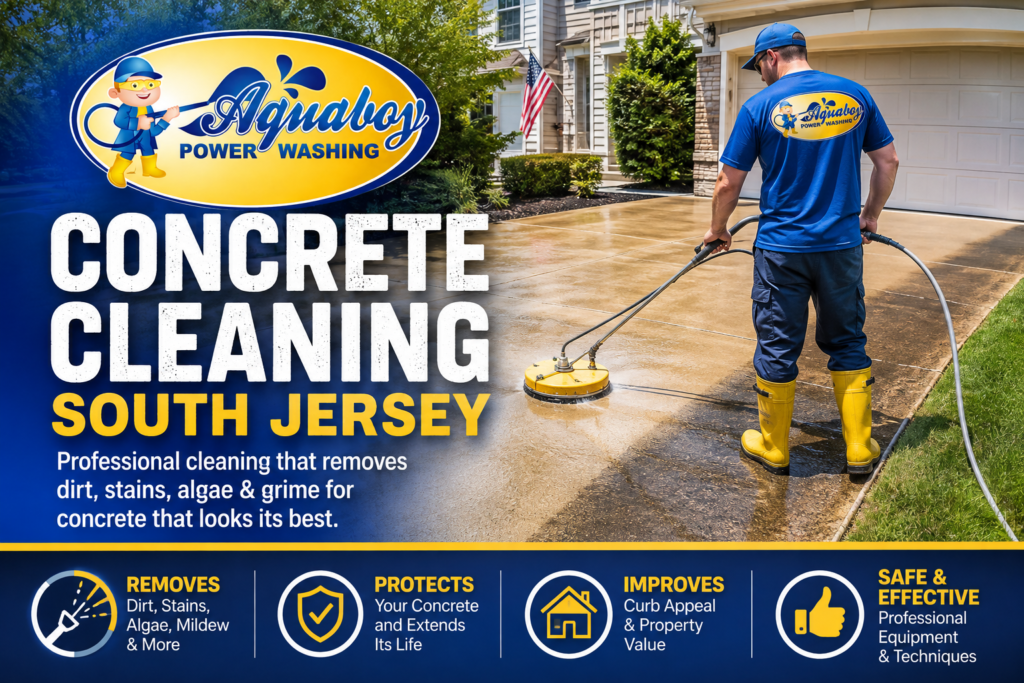
Concrete Cleaning South Jersey homeowners search for is often called driveway pressure washing, driveway cleaning, concrete pressure washing, or even concrete power washing. Whatever you call it, properly cleaning a concrete driveway involves much more than simply blasting the surface with high pressure. The right combination of professional equipment, cleaning solutions, water flow, pressure, and technique can remove years of dirt and organic buildup while reducing the risk of unnecessary damage.
At Aqua Boy Power Washing, we professionally clean concrete throughout South Jersey. One of the most important things homeowners should understand is that proper concrete cleaning involves more than pointing a pressure washer at the ground.
The type of stain, condition of the concrete, cleaning solution, equipment, pressure, water flow, and cleaning technique can all affect the final result.
This guide explains how professional concrete cleaning works, what stains can and cannot usually be removed, and what South Jersey homeowners should know before having their concrete cleaned.
Quick Answer: What Is Professional Concrete Cleaning?
Professional concrete cleaning is the process of removing surface dirt, organic growth, grime, and other contaminants from concrete using the appropriate combination of cleaning solutions, water flow, pressure, and professional surface-cleaning equipment.
For many residential surfaces, a professional cleaning process may include:
- Inspecting the concrete and identifying stains
- Applying an appropriate cleaning solution when needed
- Allowing the solution time to work
- Cleaning the surface with professional equipment
- Rinsing away loosened contaminants
- Treating remaining organic staining when appropriate
- Performing a final inspection
The goal isn’t simply to use maximum pressure. It is to get the best reasonable cleaning result without unnecessarily damaging the concrete.
At Aqua Boy Power Washing, our Concrete Cleaning South Jersey services are designed for driveways, sidewalks, patios, walkways, and other exterior concrete surfaces throughout the area.
Why Does Concrete Get So Dirty in South Jersey?
Concrete is porous.
Even though a driveway or sidewalk feels solid, its surface contains tiny pores that can hold moisture and contaminants.
South Jersey’s climate makes exterior concrete especially susceptible to discoloration.
Humidity, rainfall, shade, tree cover, pollen, leaves, soil, vehicle traffic, and seasonal temperature changes all contribute to dirty concrete.
Common contaminants include:
- Algae
- Mildew and organic growth
- Dirt
- Mud
- Pollen
- Leaf and acorn stains
- Tire marks
- Oil and automotive fluids
- Rust
- Irrigation staining
- Gum
- General atmospheric grime
A shaded driveway may develop dark organic growth much faster than concrete receiving direct sunlight.
Properties surrounded by mature trees can also experience heavier organic staining from leaves, berries, acorns, sap, and moisture.
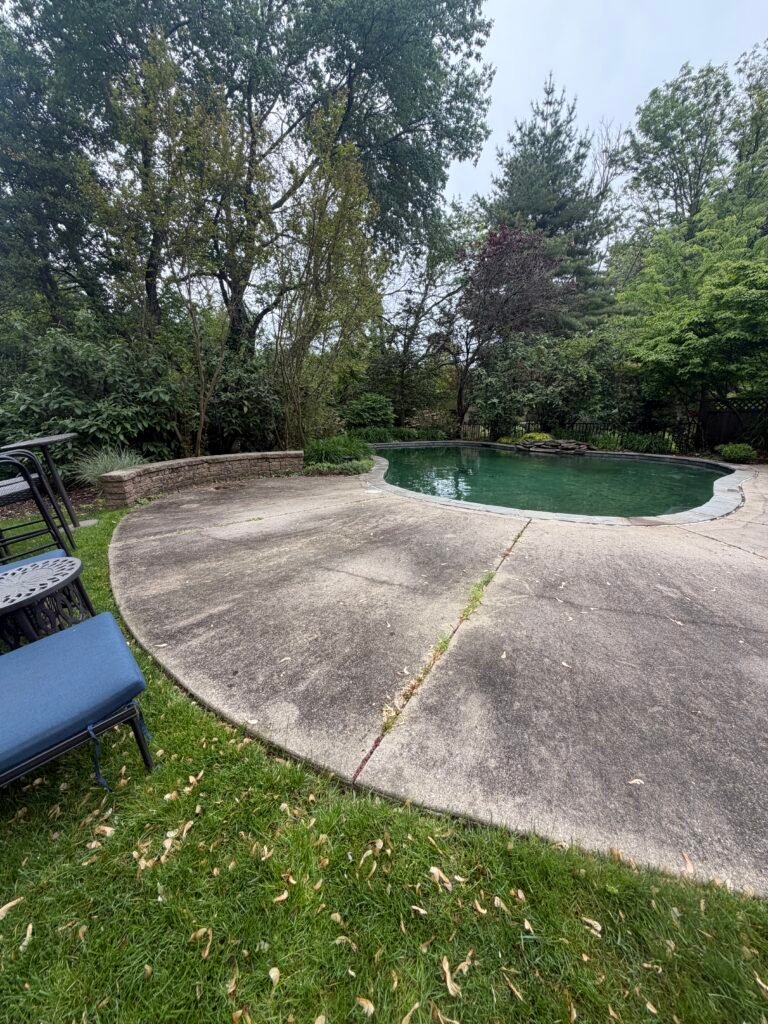
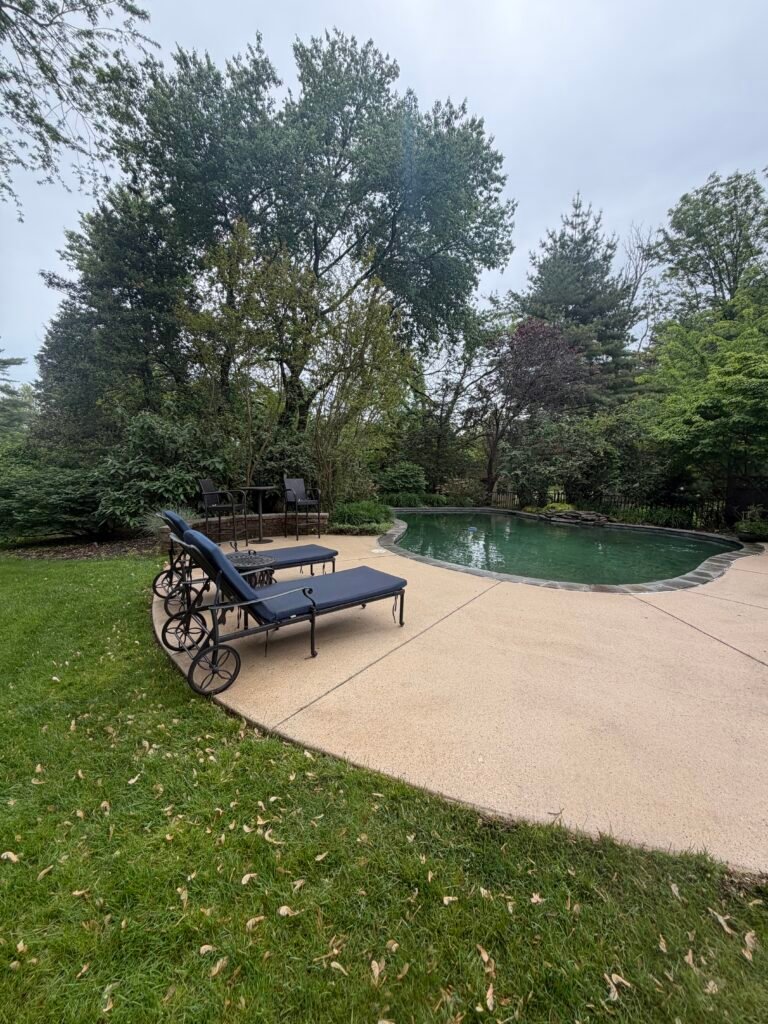
Real South Jersey Concrete Power Washing Before & After
This before-and-after from an Aqua Boy Power Washing concrete cleaning project shows the difference professional cleaning can make. The process removed accumulated dirt and organic buildup to restore a cleaner, brighter appearance to the concrete.
Pressure Washing vs. Professional Concrete Cleaning
Homeowners often use the terms interchangeably, but pressure washing is only one part of professional concrete cleaning.
Pressure washing describes the equipment.
Concrete cleaning describes the process.
A professional may use pressure as part of that process, but pressure alone isn’t always the best way to remove contamination.
Certain stains respond better to specialized cleaning solutions. Others may be permanent discoloration within the concrete and cannot safely be removed completely.
This is why an experienced exterior cleaning professional evaluates the surface before deciding how it should be cleaned.
How Is a Concrete Driveway Professionally Cleaned?
Although every property is different, professional driveway cleaning generally follows several important steps.
1. Concrete Inspection
Before cleaning begins, the surface should be inspected.
We look for conditions such as:
- Cracks
- Spalling
- Surface deterioration
- Existing damage
- Oil stains
- Rust
- Organic growth
- Leaf staining
- Previously repaired areas
- Paint or coatings
- Unusual discoloration
This step matters because not every concrete surface should be treated exactly the same way.
2. Pre-Treatment
Depending on the condition of the concrete, a cleaning solution may be applied before mechanical cleaning.
Pre-treatment helps break down organic contamination and loosen embedded grime so the equipment does not have to rely entirely on pressure.
Think of it like washing clothes.
You wouldn’t expect water pressure alone to remove every stain from a shirt. Detergent helps break contaminants down before they are rinsed away.
Concrete cleaning works on a similar principle.
3. Surface Cleaning
Large flat areas are commonly cleaned using a professional surface cleaner.
A surface cleaner uses rotating spray nozzles underneath a circular housing to clean the concrete more evenly than attempting to clean an entire driveway with a pressure-washing wand.
This helps reduce the streaks and inconsistent cleaning patterns often associated with inexperienced pressure washing.
4. Detailed Rinsing
After surface cleaning, loosened dirt and contaminants need to be thoroughly rinsed away.
Edges, corners, steps, and areas inaccessible to the surface cleaner may also require additional attention.
5. Post-Treatment When Appropriate
Some concrete may receive a post-treatment after cleaning, particularly when organic discoloration remains.
This can help address remaining organic contamination and improve the overall appearance as the surface dries.
The exact cleaning process depends on the concrete and the contamination present.
What Are Those Black or Green Areas on My Driveway?
Dark green or black discoloration is often associated with organic growth and moisture.
It commonly appears in:
- Shaded sections of driveways
- Areas near landscaping
- North-facing surfaces
- Concrete beneath trees
- Areas where water drains slowly
- Sidewalks that receive limited sunlight
Organic contamination can gradually spread across concrete if conditions remain damp.
Professional cleaning can often dramatically improve concrete affected by this type of buildup.
Can Pressure Washing Remove Oil Stains From Concrete?
Sometimes but homeowners should have realistic expectations.
Fresh oil contamination may respond well to proper degreasers and cleaning techniques. Older oil can penetrate deep into porous concrete.
Once petroleum has migrated into the concrete, complete removal may not be possible.
Professional cleaning may significantly lighten an oil stain without making it disappear completely.
Be cautious of anyone who guarantees that every old oil stain will vanish.
Concrete cleaning can remove contaminants from a surface, but it cannot always reverse permanent discoloration inside the material.
Can You Remove Rust Stains From Concrete?
Many rust stains can be substantially improved using specialized rust-removal products.
Rust treatment is different from ordinary pressure washing.
Increasing pressure usually isn’t the solution.
The stain often needs an appropriate chemical treatment designed to react with the rust.
Rust can originate from:
- Metal furniture
- Fertilizer
- Irrigation systems
- Tools
- HVAC equipment
- Metal containers
- Landscaping features
Because rust removal may require a specialty treatment, homeowners should point out these stains when requesting an estimate.
What About Orange Irrigation Stains?
Orange or brown staining caused by irrigation water is often associated with iron and other minerals.
These stains generally require specialty treatment rather than ordinary pressure washing.
The severity and age of the staining can affect how much improvement is possible.
If irrigation continues spraying iron-rich water onto the concrete after cleaning, the staining may eventually return.
Can Leaf and Acorn Stains Be Removed?
Leaf, acorn, berry, and other organic stains are extremely common around wooded South Jersey properties.
Many improve considerably with professional treatment.
However, freshly cleaned concrete may still show some discoloration immediately after washing. Certain organic stains continue to lighten after treatment and exposure to sunlight and weather.
The age and depth of the stain also affect the final result.
Why Are There Lines in My Driveway After I Pressure Washed It?
Those lines are often pressure-washing marks caused by uneven cleaning with a wand.
A pressure-washing nozzle concentrates water into a relatively small area. Moving the wand inconsistently can clean some sections more aggressively than others.
The result may look like:
- Stripes
- Zigzags
- Wand marks
- Light and dark patches
- Uneven lines across the driveway
Professional surface cleaners are designed to clean larger flat surfaces more consistently.
However, if the concrete itself has been etched or damaged by excessive pressure, cleaning may not completely correct the marks.
Can Too Much Pressure Damage Concrete?
Yes.
Concrete is durable, but its surface can still be damaged.
Excessive pressure, an incorrect nozzle, or holding the spray too close can etch the surface and create permanent marks.
New concrete can be especially vulnerable.
The appropriate cleaning method depends on factors such as the concrete’s age, condition, finish, and previous damage.
More pressure does not automatically mean cleaner concrete.
Sometimes it simply means damaged concrete.
Concrete is a durable material, but its performance and appearance can be affected by age, moisture, environmental exposure, previous damage, and improper maintenance. For homeowners interested in learning more about how concrete behaves as a material, the American Concrete Institute provides educational information on concrete fundamentals.
Should New Concrete Be Pressure Washed?
Extra caution should be used with newer concrete.
Concrete continues developing strength after it is poured, and aggressive cleaning too early can damage the surface.
If you have recently installed concrete, tell your cleaning contractor when it was poured before any pressure cleaning begins.
When the age or condition of the concrete is uncertain, a more conservative approach may be appropriate.
Why Doesn’t My Concrete Look Brand New After Cleaning?
Professional cleaning removes contamination. It does not replace the concrete.
Once dirt and organic growth are removed, existing imperfections may actually become easier to see.
These can include:
- Oil penetration
- Rust discoloration
- Previous pressure-washing damage
- Concrete repairs
- Aggregate differences
- Permanent leaf stains
- Weathering
- Spalling
- Cracks
- Efflorescence
- Uneven curing
- Previous coatings
A professionally cleaned 20-year-old driveway should look like a clean 20-year-old driveway—not necessarily newly poured concrete.
Setting realistic expectations is an important part of professional exterior cleaning.
What Is the White Powder on My Concrete?
White, powdery, or crystalline material on concrete may be efflorescence.
Efflorescence occurs when moisture moves through masonry and carries dissolved salts toward the surface. As the moisture evaporates, mineral deposits can remain behind.
Ordinary pressure washing may not permanently solve the underlying cause.
The source of moisture and type of deposit should be considered before attempting aggressive treatment.
How Often Should Concrete Be Professionally Cleaned in South Jersey?
There isn’t one schedule that works for every property.
Many homeowners consider cleaning their concrete every 1–2 years, but the ideal frequency depends on the environment.
Concrete may need attention more frequently when it is:
- Heavily shaded
- Surrounded by trees
- Exposed to frequent irrigation
- Located in a damp area
- Subjected to heavy vehicle traffic
- Developing visible algae or organic growth
Instead of cleaning according to a rigid calendar, monitor the appearance and condition of the surface.
When Is the Best Time to Clean a Driveway in South Jersey?
Concrete cleaning can be performed during much of the exterior-cleaning season when weather conditions allow.
Spring is popular because homeowners are removing winter grime and preparing outdoor areas for warmer weather.
Summer is ideal for maintaining high-traffic outdoor spaces.
Fall cleaning can help remove organic buildup associated with trees and landscaping.
The best time is generally when the concrete has become visibly dirty and weather conditions allow it to be cleaned properly.
Should I Clean My Driveway Before Selling My Home?
It can be a worthwhile curb-appeal improvement.
The driveway, sidewalk, and front walkway are some of the first exterior surfaces buyers see when approaching a property.
Cleaning cannot repair damaged concrete, but removing years of dirt and organic buildup can create a noticeably cleaner first impression.
Concrete cleaning is often combined with house washing and other exterior cleaning before listing a home.
Can I Pressure Wash My Own Driveway?
Yes, but homeowners should understand the risks and limitations.
Consumer pressure washers can remove surface dirt, but common DIY problems include:
- Wand marks
- Uneven cleaning
- Insufficient water flow
- Using excessive pressure
- Incorrect cleaning solutions
- Damaging surrounding surfaces
- Poor stain identification
- Inadequate rinsing
- Spending many hours cleaning a large area
The biggest misconception is that cleaning performance comes entirely from pressure.
Professional exterior cleaning relies on the entire process—not just PSI.
What Should I Ask a Concrete Cleaning Company?
Before hiring a company to clean your driveway, patio, or sidewalks, consider asking:
Do you use a surface cleaner?
For large flat areas, professional surface-cleaning equipment can help produce more consistent results.
Do you pre-treat concrete when necessary?
Cleaning solutions can be an important part of removing organic contamination.
Can every stain be removed?
A reputable contractor should explain that some stains and permanent discoloration may remain.
Are you insured?
Exterior cleaning involves professional equipment, water, chemicals, and work around valuable property.
How will you protect surrounding landscaping and property?
The contractor should have procedures for working around plants, structures, vehicles, and adjacent surfaces.
Concrete Cleaning vs. Concrete Restoration
These services are not the same.
Concrete cleaning removes dirt and contaminants from the existing surface.
Concrete restoration may involve repairs, resurfacing, grinding, coatings, sealing, or other methods intended to physically alter or restore the concrete.
If a driveway is badly cracked, spalling, permanently etched, or structurally deteriorated, pressure washing will not repair those problems.
Cleaning can reveal the concrete’s actual condition, but it cannot rebuild damaged material.
Does Concrete Cleaning Increase Curb Appeal?
In many cases, the difference can be dramatic.
Concrete occupies a large visual area around many South Jersey homes. A dark driveway or green sidewalk can make an otherwise well-maintained property appear neglected.
Cleaning the driveway, front walkway, sidewalks, and patio can help brighten the overall exterior without replacing anything.
That makes concrete cleaning a popular service before:
- Graduation parties
- Backyard events
- Holidays
- Home listings
- Professional photography
- Exterior painting projects
- Spring property maintenance
Concrete Cleaning in Marlton, Medford, Cherry Hill, Voorhees, Haddonfield and South Jersey
Concrete conditions can vary considerably from property to property throughout South Jersey.
A shaded driveway beneath mature trees in Haddonfield may have different cleaning needs than an open driveway in Marlton.
A wooded property in Medford may experience heavy leaf and organic staining, while properties in Cherry Hill or Voorhees may have combinations of traffic grime, algae, irrigation stains, and automotive contamination.
That’s why we believe concrete should be evaluated based on its actual condition rather than treated with a one-size-fits-all approach.
Aqua Boy Power Washing provides professional concrete and exterior cleaning services throughout Marlton, Medford, Cherry Hill, Voorhees, Haddonfield, Evesham Township, and surrounding South Jersey communities.
Frequently Asked Questions About Concrete Cleaning
Does pressure washing remove every stain from concrete?
No. Professional cleaning can remove or significantly improve many contaminants, but permanent discoloration, deep oil penetration, rust, previous damage, and other conditions may remain.
Is pressure washing safe for concrete?
It can be when appropriate equipment and techniques are used on concrete that is suitable for pressure cleaning. Excessive pressure or improper technique can damage the surface.
Why is my driveway black?
Dark concrete is commonly associated with accumulated dirt, moisture, and organic growth, particularly in shaded areas. An inspection can help determine what is causing the discoloration.
Will my driveway be perfectly even after cleaning?
Not necessarily. Concrete can have natural variations, repairs, stains, weathering, and previous damage that become visible once surface contamination is removed.
Do you use chemicals to clean concrete?
Cleaning solutions may be used depending on the contamination and condition of the surface. Professional concrete cleaning often combines chemistry with mechanical cleaning rather than relying exclusively on pressure.
Can you clean sidewalks and patios at the same time?
Yes. Driveways, sidewalks, walkways, patios, and other suitable concrete surfaces can often be cleaned during the same service visit.
Can old oil stains be completely removed?
Not always. Oil can penetrate porous concrete. Professional treatment may substantially improve a stain even when complete removal isn’t possible.
Will algae come back after concrete cleaning?
Eventually, organic growth can return because cleaning does not change environmental conditions such as shade, moisture, drainage, and humidity. Keeping the area drier and improving sunlight exposure where practical may slow regrowth.
Is a surface cleaner better than using a pressure-washing wand?
For large, flat concrete areas, a professional surface cleaner generally provides more consistent coverage. Wands are still useful for edges, detail work, rinsing, and areas a surface cleaner cannot reach.
The Bottom Line
Professional concrete cleaning is about much more than pressure.
The best results come from understanding what is on the concrete, what condition the concrete is in, and which cleaning process is appropriate for that particular surface.
Organic growth and surface grime can often be dramatically improved. Oil, rust, irrigation staining, previous pressure damage, and permanent discoloration may require specialty treatment or may not disappear completely.
That’s an important distinction because professional exterior cleaning should be based on realistic expectations—not promises that every stain can magically be erased.
If your driveway, sidewalk, walkway, patio, or other concrete surfaces are looking dark or stained, Aqua Boy Power Washing provides professional concrete cleaning throughout South Jersey.
Serving Marlton, Evesham Township, Medford, Cherry Hill, Voorhees, Haddonfield, and surrounding South Jersey communities.
Want to know what can realistically be cleaned from your concrete? Request an estimate from Aqua Boy Power Washing and we’ll evaluate the surface and recommend the appropriate cleaning approach.
Looking to have your driveway or concrete professionally cleaned? Learn more about our South Jersey concrete cleaning and pressure washing services.